governed agent-to-hardware · running in your browser
An AI agent drives a motor. The boundary decides what actually happens.
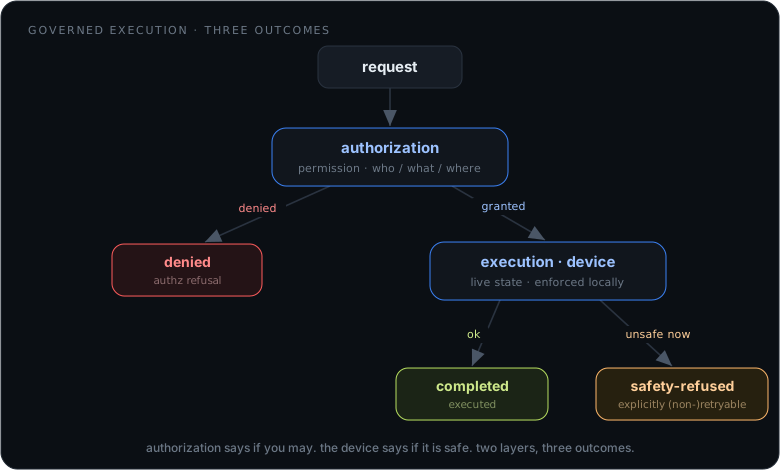
The agent expresses intent through MCP. Then three layers decide, bottom-up: a policy says who may act, the device clamps to a safe envelope, and a hardware disengage overrides everything below the software path. Authorized does not mean safe.
This motor is simulated and runs in this page as an MCP server. It is the twin of a real 3-phase controller: point a provider at the same slot and the exact same calls drive real hardware. Natural language is never the safety mechanism here.
Policy (who / what / where)
Safety envelope (device clamps)
Hardware e-stop (physical override)
Device · motor-1 (MCP provider)
resource /acme/lyon/assembly/line-3/cell-2/motor-1
CRITICAL OP
SPEED
0 rpm
CURRENT
0.0 A
TEMP
24 °C
Hardware e-stop. Latching. Overrides policy and agent. No software path can rearm it.
Critical operation. A cycle that must not be interrupted. While active, the device refuses anything that would halt it,
stop and set_speed below the floor alike: safety guards the effect, not the method name. The hardware e-stop still overrides.resources/read · motor-1/safetyadvisory · non-authoritative
Advisory only. It reports live conditions and the operations the device is currently refusing. Observing a value is never proof the next call is safe: the device re-checks at execution.
Caller · token & controls
Audit log · every call, every decision
Simulated twin of a real controller. The same MCP calls drive real hardware through
mcp-broker.
Safety limits live in the device and the hardware, never in prompt text.